Wednesday, March 25, 2020

Ardusimple simpleRTK2B with Long Range Radio and Bluetooth

When you need high precision Global Navigation Satellite System (GNSS) support, one of the best economical choices is the Ardusimple simpleRTK2B. I am using the Long Range Starter Kit that consists of a base station and a rover. By using 2 simpleRTK2B boards that communicate with each other, I am able to take advantage of Real-Time Kinematic (RTK) positioning which gives me centimeter accuracy. The simpleRTK2B has a convenient connector for Xbee radio modules which in my case is used for the long range radio. However, I would also love to use the XBee Bluetooth Module on the rover. That way I don't have to connect my Android-based smartphone via USB cable, but can also conveniently connect to the simpleRTK2B via Bluetooth. Unfortunately, for this use-case I have to wire up the XBee Bluetooth Module manually as there is only a single Xbee radio slot. The documentation on this was a bit sparse but the following pointers were useful:

I finally got everything working with the following wiring. The one thing that feels a bit odd is the need to also connect the 3.3V OUT on the simpleRTK2B to its IOREF pin.


Monday, December 25, 2017

Mapping Options with Angular 5

Just did a quick search on Angular components for either Google Maps or OpenStreetMap. For Google Maps the choice du jour seems to be Angular Google Maps (Git repo). A neat little blog post on how to get started is here.

When targeting OpenStreetMap, Leaflet.js is still the most popular library out there. While it is "just" a JavaScript library, you can use it directly in your Angular project or use dedicated components, of which the following 2 seem worthwhile to investigate further:

Monday, April 4, 2016

Spring Boot with JSPs using Undertow

This is a follow-up to my previous post Spring Boot with JSPs in Executable Jars.

Undertow is another alternative for using an embedded container with Spring Boot. You can find general information in the Spring Boot reference guide chapter Use Undertow instead of Tomcat. While I was working on updating the Spring Boot documentation regarding the JSP support for Tomcat, I noticed the following line in the reference guide for Spring Boot 1.3.3:

"Undertow does not support JSPs."

Being a good citizen, I dug a little deeper and discovered the Undertow JSP sample application by Chris Grieger. It turns out that Undertow has indeed JSP support by using jastow, which is a Jasper fork for Undertow. The key was to adapt the Undertow JSP sample application for Spring Boot. Doing so was actually fairly straightforward. The actual Undertow configuration uses Spring Boot`s EmbeddedServletContainerCustomizer:


final UndertowDeploymentInfoCustomizer customizer = new UndertowDeploymentInfoCustomizer() {

  @Override
  public void customize(DeploymentInfo deploymentInfo) {
    deploymentInfo.setClassLoader(JspDemoApplication.class.getClassLoader())
    .setContextPath("/")
    .setDeploymentName("servletContext.war")
    .setResourceManager(new DefaultResourceLoader(JspDemoApplication.class))
    .addServlet(JspServletBuilder.createServlet("Default Jsp Servlet", "*.jsp"));

    final HashMap<String, TagLibraryInfo> tagLibraryInfo = TldLocator.createTldInfos();

    JspServletBuilder.setupDeployment(deploymentInfo, new HashMap<String, JspPropertyGroup>(), tagLibraryInfo, new HackInstanceManager());

  }
};

The full source is available in the JspDemoApplication class. The main issue is more or less the retrieval and configuration of the used Taglibraries. The Undertow JSP sample provides the TldLocator class, which does the heavy lifting. For our example, I am adapting that class so that it works in the context of Spring Boot. In Spring Boot we are dealing with über-Jars, meaning the resulting executable jar file will contain other jar files representing its dependencies.

Spring provides some nifty helpers to retrieve the needed Tag Library Descriptors (TLD) files. In TldLocator#createTldInfos I use a ResourcePatternResolver, specifically a PathMatchingResourcePatternResolver with a location pattern of classpath*:**/*.tld.


final URLClassLoader loader = (URLClassLoader) Thread.currentThread().getContextClassLoader();

final ResourcePatternResolver resolver = new PathMatchingResourcePatternResolver(loader);
final Resource[] resources;
final String locationPattern = "classpath*:**/*.tld";

try {
 resources = resolver.getResources(locationPattern);
}
catch (IOException e) {
 throw new IllegalStateException(String.format("Error while retrieving resources"
   + "for location pattern '%s'.", locationPattern, e));
}


Important

Don’t forget the asterix right after classpath. The classpath*: allows you to retrieve multiple class path resources with the same name. It will also retrieve resources across multiple jar files. This is an extremely useful feature. For more information please see the relevant JavaDocs for PathMatchingResourcePatternResolver.

Once we have the TLD resources, they will be parsed and ultimately used to create a collection of org.apache.jasper.deploy.TagLibraryInfo. With those at hand, we create a JSP deployment for Undertow using the DeploymentInfo and the TagLibraryInfo collection.


final HashMap<String, TagLibraryInfo> tagLibraryInfo = TldLocator.createTldInfos();
JspServletBuilder.setupDeployment(deploymentInfo, new HashMap<String, JspPropertyGroup>(), tagLibraryInfo, new HackInstanceManager());

And that’s it. Simply build and run the application and you should have a working JSP-based application.


$ mvn clean package
$ java -jar jsp-demo-undertow/target/jsp-demo-undertow-1.0.0-BUILD-SNAPSHOT.jar

In your console you should start seeing how the application starts up.


Once started, open your browser and go to the following Url http://localhost:8080/.


You can find the full source-code for this sample at https://github.com/ghillert/spring-boot-jsp-demo

Friday, February 12, 2016

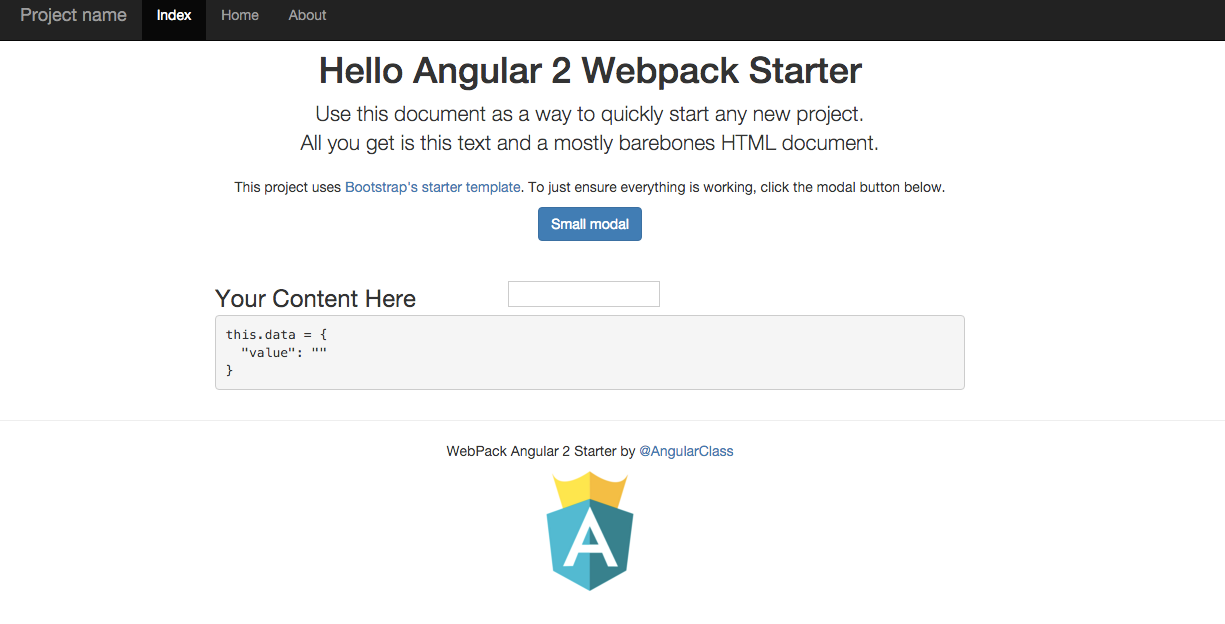
Starter Project - Angular 2.0 + TypeScript + WebPack + Bootstrap

As Angular 2.0 is finally in Beta (¡Yeah!), it is playtime now. In my opinion, the best starter project to use (Feb 2016 ;-) is Angular2 Webpack Starter by AngularClass. Unfortunately, it does not come with Bootstrap support out of the box. This is typically not a major issue but many front-end developers will be faced with 2 major changes:

  • Grunt, Gulp and Bower are dead, long live NPM and Webpack
  • TypeScript rules but how do I "require" my CSS dependencies?
Therefore, I created fork of the aforementioned starter project adding Bootstrap support. Also, in order to customize your Bootstrap theme, I believe it is advisable to use either Less or Sass. As I am more familiar with Less, I added it to my setup as well.


Monday, October 12, 2015

AngularJS + Karma - Loading JSON Files for Mocking HTTP Responses

In order to kick-off AngularJS projects, I have been looking at generator-gulp-angular lately, which you can find at:

https://github.com/Swiip/generator-gulp-angular

When doing your unit tests, it is quite convenient to mock HTTP responses using JSON files. However, having your unit tests load additional (JSON) files may not be super obvious using the Karma test runner.

bower.json

For the task at hand, I am using jasmine-jquery which provides “jQuery matchers and fixture loader for Jasmine framework”. Add that dependency to your bower.json file:


"devDependencies": {
  
  "jasmine-jquery": "2.1.1"
}


karma.conf.js

Now we need to do some additional configuration for Karma. By default, generator-gulp-angular wires the needed files up with:


return wiredep(wiredepOptions).js
  .concat([
    path.join(conf.paths.tmp, '/serve/app/index.module.js'),
    path.join(conf.paths.src, '/**/*.spec.js'),
    path.join(conf.paths.src, '/**/*.mock.js'),
    path.join(conf.paths.src, '/**/*.html'),
    {pattern: path.join(conf.paths.src, '../mocks/**/*.json'), watched: false, included: false, served: true}
  ]);


In order to make your JSON file available, add


{
  pattern: path.join(conf.paths.src, '../mocks/**/*.json'),
  watched: false,
  included: false,
  served: true
}


So that it becomes:


return wiredep(wiredepOptions).js
  .concat([
    path.join(conf.paths.tmp, '/serve/app/index.module.js'),
    path.join(conf.paths.src, '/**/*.spec.js'),
    path.join(conf.paths.src, '/**/*.mock.js'),
    path.join(conf.paths.src, '/**/*.html'),
    {pattern: path.join(conf.paths.src, '../mocks/**/*.json'), watched: false, included: false, served: true}]);


Mocks is a directory in my project’s root folder. Customize as needed. For further details see:

http://karma-runner.github.io/0.13/config/files.html

Now, you're ready for testing. In your spec aka unit test file, in the beforeEach:


beforeEach(inject(function (_$httpBackend_, _$rootScope_, $controller) {
…
}));


you can now mock up the $httpBackend:


jasmine.getJSONFixtures().fixturesPath='/base/mocks';

$httpBackend.whenGET('http://localhost:9876/api/plants').respond(
   getJSONFixture('plants.json')
);
$httpBackend.whenGET('app/components/plants/plants.html').respond('');
$httpBackend.flush();

Saturday, October 3, 2015

AngularJS Best Practices - Style Guide

Looks like the place du-jour for THE AngularJS style guide is here:

https://github.com/johnpapa/angular-styleguide

The author, John Papa, also provides the HotTowel Yeoman generator, that implements this style-guide:

https://github.com/johnpapa/generator-hottowel

If you're a TypeScript aficionado, you may want to keep an eye on the following GitHub issue:

https://github.com/johnpapa/generator-hottowel/issues/90

In the meantime - checkout:


And all this came up, as I was looking, for some good explanation for the advice to use AngularJS’
“Controller as” syntax and to avoid $scope as much as possible.

https://github.com/johnpapa/angular-styleguide#style-y030

A really good explanation is also here:

http://toddmotto.com/digging-into-angulars-controller-as-syntax/

Friday, October 2, 2015

TypeScript versus ES6


A good question is: Why would you want to use TypeScript versus ES6?

A few reasons for me:

  • I have to use a transpiler anyway in order to support older browsers such as Babel
  • TypeScript gives me types
  • You can still use JavaScript as valid TypeScript (TS being a superset of JS)
  • It seems to be a more natural fit for Java developers
  • Tooling support seems pretty good
  • AngularJS 2.0 will use it natively - as such you have Google and Microsoft supporting it

Resources

Will ES6 make Typescript irrelevant?
https://www.reddit.com/r/javascript/comments/31qocr/will_es6_make_typescript_irrelevant/

TypeScript vs ECMAScript 2015/2016
http://ilikekillnerds.com/2015/07/typescript-vs-ecmascript-20152016/

TypeScript and ES6 Dan Wahlin & Andrew Connell


Angular Air Episode 25: TypeScript or ES6 with Babel?


Thursday, October 1, 2015

AngularJS 1.x and TypeScript

I did a bit of research today on TypeScript. As it is favored (but not required) for the upcoming AngularJS 2.0 release, I wanted to dig a bit deeper. Keep in mind that as of Oct 2015, AngularJS 2.0 is still a pure alpha version and even new projects shall continue using AngularJS 1.4.

Nonetheless, it looks like TypeScript is a viable option even for the latest 1.4 version. In fact, Yeoman now provides an Angular starter (generator-gulp-angular) that gives you the option to use TypeScript as your language of choice.

Here are some resources that I thought were helpful:

http://www.developerhandbook.com/typescript/writing-angularjs-1-x-with-typescript/

I believe, that particularly for Java Developers, TypeScript could be quite interesting - as you have much better type-safety compared to using plain JavaScript. See the following blog entry by Veit Weber:

Why Java Developers might love TypeScript

There is a good presentation by Sander Mak from JavaOne: "TypeScript for Java Developers: Coding JavaScript Without the Pain" on that subject as well:


A longer version:


As you can have a much better OO experience with TypeScript, I think it will be also quite interesting to use rich domain objects with AngularJS rather than using JSON structures directly when retrieving data from your REST endpoints.

There is a great presentation by Gert Hengeveld from NG-NL 2015.


Slides: 

https://docs.google.com/presentation/d/1cbNH2WHO8WzF1XKPxMJ3gJXmfKnWAl3cN77eJJJdAEw/present?slide=id.p

Blog Post:

https://medium.com/opinionated-angularjs/angular-model-objects-with-javascript-classes-2e6a067c73bc

Convert JSON Structure to TypeScript Classes

If you create TypeScript classes that need to handle JSON, the follow online tool to generate TypeScript interfaces from JSON might be of interest:

http://json2ts.com/

TypeScript type definitions

I still need to wrap my head around TypeScript type definitions. They basically bolt on type definition for libraries that are not inherently based on TypeScript. There is a repository for them:

https://github.com/borisyankov/DefinitelyTyped


Monday, March 2, 2015

Still want to go to DevNexus 2015 (for free)? Room Volunteers Needed!

We are still looking for a few more room volunteers to help us with the monitoring and basic quality control of the breakout session rooms at DevNexus 2015 next week.

In total we need 24 volunteers (12 tracks x 2 days) for the 2 main conference days (March 11 and 12)  It will be first come, first serve - So please apply ASAP. We will be accepting room monitors from now and up until Thursday, March 5th.

The room monitor will be responsible for:

  • Getting a copy of the presentation slides from speakers right after each session
  • Making sure speakers don't go over their allotted time
  • Communication of any room related issues (power, sound , temp... etc).
  • Count the attendees in each session
  • Provide some feedback in regards to the observed sessions

A volunteer will be in charge of a single track room for one full day. Then s(he) will be free all day on the alternate conference day. For example, you monitor the Agile session room on Wednesday, then you are free to attend any session on Thursday.

Please contact info at ajug dot org if you are interested with the following info:

  • Day and Track
  • Alternative Day and Track 
  • Name
  • Email
  • Phone

Also, let us know if you have any further questions.

THANKS!

Saturday, January 10, 2015

DevNexus 2015 at BMW's Car Hackathon


Thanks to my colleague Sabby Anandan, DevNexus 2015 is getting some mentioning at BMW's Car Hackathon - Hack The Drive in San Francisco. The event takes place this weekend January 11-12.

Details at: http://hackthedrive.com/

Here are some photos:


Thursday, January 8, 2015

DevNexus 2015 - Early Bird pricing ends Jan 9

The countdown for DEVNEXUS 2015 (Workshop day March 10, main conference March 11-12) is on! The AJUG team has been working hard to secure speakers, build the new event site and make this year's event the best one ever:

  • 3 days (1 workshop day and 2 conference days) 
  • 12 tracks 
  • 120 sessions 
  • expected attendance of 1500 

You can see the accepted list of speakers and sessions at http://www.devnexus.com/.

Please note that the Early Bird pricing ends this Friday Jan 9th!! So if you want to take advantage of the super low event price of $250 (other developer conferences of this scale cost $1000-$1800 to attend) then register this week.

Also don’t forget that we have a whole day of workshops on March 10th. This conference has sold out every year for the last 6 years so be sure to register now at:


A big THANK YOU to all of our sponsors that help make this event possible:

PLATINUM SPONSOR


GOLD SPONSORS


MEDIA PARTNER


SILVER SPONSOSRS


COCKTAIL HOUR SPONSOR


See you all in March!!!

Tuesday, December 2, 2014

Npm, Bower, CI and the Network

Ok, I accepted the reality that building single-page applications (SPA) is better done using the tooling options embraced by the JavaScript community, rather than building those apps using purely Gradle or Maven (and respective plugins). The reason being that building a complete web-UI is rather involved and tools like Yeoman, Grunt (Gulp) and Bower provide quite a bit of useful tooling while also having a much larger user-base than the (less complete) options in the Java world.

So life was good. Everything builds. Of course we still need to integrate the app with our backend that provides the REST endpoints. Personally, I prefer it that developers can build the entire stack at once. Also, can we assume that every (Java) developer has Node/Npm intalled?

Luckily, there are some plugins available for Maven and Gradle that provide useful wrappers around Npm and Node:
Thus, with some trial and error you get a fairly portable build (Linux, Mac and Windows) that not only executes the Grunt build but also downloads and installs Node and its dependencies, Grunt, Bower etc.

You think you finally arrived...Things run mostly okay on the continuous integration (CI) server...mmh, wait... "Mostly" is causing some headaches. This is actually an area where I have some frustrations lately. Looks like the Maven Central in the node world is a tad more volatile than Maven central itself.

In the Java world you have 2 layers of protection that ensure that the CI server build process is fairly resilient to internet hick-ups. Heck, it would even build off-line (assuming no library dependency changes were done). First, you have your local repository of course, which in the case of Maven is typically ${user.home}/.m2/

Second, any serious CI environment would also use a dedicated repository manager that serves as a proxy to the outside world, so that for already retrieved dependencies you would not need to hit Maven Central or other 3rd party repositories.

With NPM you all of a sudden realize you are a tad back into the wild west. Not only do you have to consider NPM (Managing tooling dependencies) but Bower (managing JS/CSS dependencies) as well.

NPM actually provides npm-cache - and you see dependencies being cached in your home directory under ~/.npm/. But try to disable your network card...the eternal spinner is yours. It does not even seem to timeout.

You can go offline - kind of - using “npm install --cache-min 9999999 --no-registry” but it does not seem to support things the way Maven/Gradle does: Check the cache first, and only if the dependency does not exist fetch it remotely. See also: https://github.com/npm/npm/issues/2568

Another issue I encountered is with using Protractor for the E2E testing of my AngularJS application. You will usually use webdriver-manager to retrieve the necessary Selenium files/driver for your targeted Browser, e.g. Chrome. Since, I like to make the build as portable as possible, I do a post-install of the web-driver manager, which requires direct network access in package.json:

"scripts": {
  "postinstall": "node_modules/protractor/bin/webdriver-manager update"
}

Bower unfortunately, does its own caching approach which is configured in .bowerrc, e.g.:

"storage": {
"packages": ".bower_cache"
}

So what about using dedicated repository managers as proxy for NPM and Bower?

Artifactory provides support for NPM but not Bower. There is a feature request to support Bower in Artifactory, though. Nexus also has support for NPM. For Bower an open ticket exists.

Maybe people should start rallying behind web-jars more broadly ;-(


Monday, October 13, 2014

Digging Deeper - RequireJS and ES6 Modules

I was exploring RequireJS and ES6 Modules some more this weekend. Originally I started to explore how I can use richer domain objects (classes) as part of our AngularJS application that uses RequireJS for modularization. As part of that endeavor, using RequireJS looks like an interesting approach to inject classes into the application (Remember that AngularJS injects class instances ;-)

Here is a list of interesting resources that I came across.

RequireJS Basics

In order to get a refresher/introduction to RequireJS, I found Rob Dodson's RequireJS -- Embracing the Awesomeness of Asynchronous Modules quite nice:
Integrating AngularJS and RequireJS

Thomas Burleson's Angular and RequireJS from ng-conf 2014 was high on my consumption list. I think his explanation of how RequireJS relates to AngularJS was perfect.
I thought his code example was a tad on the complex side, though (Meaning I may need to revisit it ;-). For practical purposes, I then discovered Burke Holland's Requiring vs Browserifying Angular which I think is the nicest tutorial I came across:
The tutorial also underlines the point that using AngularJS and RequireJS is not for the faint of heart. It has its challenges. Maybe I need to look at Browserify?

One challenge I came across this morning for example,  is to make angular-masonry work with RequireJS. I was able to solve that challenge using this Stackoverflow posting:
Whats is coming with ES6 Modules

When looking at modules, it does not take long to come across ES6 Modules, the next hot thing coming our way as part of ECMAScript 6 (see Using ECMAScript 6 today)

First I watched Browser Package Management (by Guy Bedford):
He also has a nice blog post:

http://guybedford.com/practical-workflows-for-es6-modules

Another good video was Guy Bedford's talk: Package Management for ES6 Modules from JSConf2014:
What was interesting to learn, is that with SPDY, the bundling of web-resources won't be necessary anymore (eventually). See Multiplexing with SPDY and HTTP/2 for explanations:
So here is what is next for me...I need to look at the following projects and see how all this is usable today. Certainly looks fascinating being to use ES6 features right now, also keeping in mind that AngularJS 2.0 will use ES6 modules.

Monday, October 6, 2014

Java Template Engines Revisited Part 1

Over the past week, I spent some time looking at Java based template engines. Typically I need templating support for two areas:

  • View Templates (For rendering views in your browser)
  • Email Templates - with support for both HTML and Text emails

For email templates I had used the usual suspects such as Velocity and Freemarker in the past but both feel a tad heavy and old these days - Velocity's last release was in 2010! Eventually I settled for a simpler option a while back: StringTemplate, which as a library worked fairly okay.

As I had done some client-side templating using Mustache and Handlebars, I was intrigued in seeing Java implementations for both:


The nice thing about Mustache is that implementations are available for almost any programming language imaginable, which could be nice in case you have the need to maintain browser-bound and backend (Java) templates or in case you have multiple Java and non-Java application with templating needs.

For now I have chosen mustache.java. Looks like it is heavily used at Twitter. Depending on how willing you are towards enduring any type of logic in your templates, you may also want to check out Handlebars and the corresponding Java implementation. It is basically a super-set of Mustache, providing additional built-in helpers.

Lastly, for both Mustache and Handlebars there is support available for Spring MVC.


I have not used either support for Spring MVC, yet, though. In case you have used any of the mentioned options, please leave feedback to this blog.


Monday, September 15, 2014

Secure your AngularJS Apps with Spring Security and Spring Session


A few days ago I was in the middle of preparing for my Spring One 2GX 2014 talk Creating Modular Test-Driven SPAs (Slideshare) with Spring and AngularJS. Part of the presentation is a demo application I created called botanic-ng. This application uses AngularJS on the client side and Spring (Boot) on the server-side. As I wanted to not merely create a simplistic toy app, I also intended to add authentication and (simple) authorization to the application.

I did not want to go too crazy with this (e.g. implementing full-fledged OAuth 2.0 integration). Nevertheless, I wanted to add (I hope) some meaningful security features inside my AngularJS application.

Disclaimer: I am not a security expert. Proceed with caution as this solution may not provide enough security for your application needs.

By chance I came across a demo application that Josh Long created a while back. That application, while using Spring Security, did not integrate with Spring Security to the fullest extends, and I felt that I could improve upon that implementation using Spring Session which is new project created by Spring Security lead Rob Winch.

Spring Session

The Servlet 3.0 Specification (JSR 315) introduced several ways to customize the handling of session cookies, for instance changing the name of the cookie (from the default JSESSIONID) and providing additional security relevant settings:


However, you're still pretty much bound to using cookies in order to store your Session IDs. For cases where you need more comprehensive flexibility for handling your sessions, Spring Session comes in quite handy and provides numerous advantages.

By default Spring Session stores session information in Redis using the RedisOperationsSessionRepository. Sessions expire by default after 30 minutes but this can be customized using the setDefaultMaxInactiveInterval property. Beyond Redis a MapSessionRepository is also provided to allow for easy integration with e.g. Hazelcast.

For my use-case, I wanted to expose the Session ID not via a standard cookies but via an HTTP header. Luckily, Spring Session provides various pluggable strategies to customize that behavior. As Spring Session works as a Filter you have to configure a SessionRepositoryFilter. On this filter you can set the used HttpSessionStrategy. By default it uses the CookieHttpSessionStrategy. For my use-case, though, I am using the HeaderHttpSessionStrategy, which by default stores the Session ID in an HTTP header called x-auth-token (This is customizable though).

On the client-side in my AngularJS application, I am adding a HTTP header via $http to every request.

$http.defaults.headers.common['x-auth-token'] = user.token;

This is configured upon successful login through the LoginControllerBotanic-ng submits the login credentials to the server, which in turn uses them to authenticate the user using Spring Security (AuthenticationController) and if successful, the AuthenticationToken containing the Session ID and user roles will be send back to the client.

The Session ID on the client is stored in memory only and if you refresh the client, the user must re-authenticate.

For the full source code, please see: 


Saturday, September 13, 2014

Spring One 2GX 2014 - My session slides

Have not blogged in a while. Need to make a mental note to revive that. Just came back from Spring One 2GX 2014 in Dallas, TX. It's been a wonderful event and I learned a lot - From microservices to reactive streams. I also gave 2 presentations which I think were well received. For my AngularJS with Spring (Boot) talk I had 140 attendees, yeah :-)

Creating Modular Test-Driven SPAs with Spring and AngularJS


Spring Batch Performance Tuning


Thursday, December 5, 2013

DevNexus 2014 - Feb 24-25 - Atlanta - 10+1 Tracks - 100 sessions

The preparations for DevNexus 2014 are in full swing and we are targeting to have the biggest and boldest DevNexus developer conference ever. DevNexus will take place February 24-25 at the Cobb Galleria Centre in Atlanta, GA. With the holiday season upon us, why not reward yourself with a DevNexus ticket?

Registration is now open at: http://www.devnexus.com

Best of all, DevNexus will not break your wallet. The Early Bird Pass is available for $210 ($240 regular) and the Group Pass for groups of 5 or more is $210. We also have a $150 Student Pass available (Contact us for the code - info at ajug dot org). Keep in mind not to wait too long as DevNexus has sold out completely in the past couple of years.

This year we will offer 10 parallel tracks + 1 workshop track covering a wide spectrum of topics such as:
  • Java/JavaEE/Spring
  • HTML5
  • JavaScript
  • Data + Integration
  • Alternative Languages on the JVM
  • User Experience
  • Cloud
  • Agile + Tools
  • Mobile
In total we will have almost 100 sessions for you! 

Currently the call for papers is still under way and the response so far has been nothing short of phenomenal. Already we have started confirming a few speakers. We are excited to have Brett Meyer, a core Hibernate team member. Mark PollackSpring Data and Spring XD co-lead as well as Rob Winch, the lead developer for Spring Security will present as well. Furthermore, industry experts such as Venkat Subramaniam and Peter Bell are confirmed to speak. Over the next couple of weeks you will see an explosion of new speakers and sessions being added to the DevNexus website at:


Please check in often to see the progress! Also, we are very excited to announce our first keynote presenter who will fly in all the way from Germany: Sven Peters is a software geek working as an ambassador for Atlassian. He has been developing Java applications for over 12 years and leading small teams using lean methodologies. Sven likes effective software development and cares about the motivation of developers.

He will present:

How To Do Kick-Ass Software Development

With Kick-Ass Software Development you actually get stuff done. Feedback cycles are short, code quality is awesome and customers get the features they lust after. Less mangers managing, less testers testing and less IT-operators operating. The developers take the power back, making them much happier. Sound like paradise? It is! This session will show you how we do Kick-Ass Software Development at Atlassian. I will talk about how we: use pull requests for better code quality; collaborate fast to develop ideas; avoid meetings to get more stuff done; tighten our feedback loops to fail faster; shorten our release cycles; and work together happily on different continents. It's a great way to develop software and we think it can work in your company, too.

With this line-up of topics and many more to come, attending DevNexus should be a top priority - This is the South-East’s best, yet affordable, developer conference! We, the volunteers from the Atlanta Java Users Group would be delighted to see you all at DevNexus! Learn, network and have fun -

We would like to thank all our Sponsors that help us greatly to keep DevNexus super-affordable.

Platinum Sponsor:
Gold Sponsors:
Silver Sponsors:
Cocktail Hour Sponsor:
We are looking forward seeing you all in February!!!

Please register today at: http://www.devnexus.com

If you have any questions let us know at info at ajug.org and please follow
us on Twitter at http://twitter.com/devnexus for news and updates.

Monday, October 28, 2013

DevNexus 2014 - Atlanta (Feb 24-25) - Call for Papers

The Atlanta Java Users Group is in the middle of organizing its annual developer conference for 2014. 

We are excited to announce that the Call for Papers is active now. Please spread the word among your peers and if your are interested we would love if you submit session proposals for our conference at:


This is what we plan so far:

DevNexus 2014 is on February 24-25 (Monday and Tuesday). We plan on having 1000+ attendees with 10 parallel tracks and 1 workshop track. This equates to:
  • 90+ sessions (75min each)
  • 4 workshops
  • 2 keynotes (60 min each)
Topic-wise we plan to cover the following:
  • Java/JavaEE/Spring
  • HTML5 + JavaScript
  • Data + Integration
  • User Experience
  • Alternative Languages on the JVM
  • Cloud
  • Agile
  • Tools
  • Mobile
Here is a short promo video that we did during DevNexus 2013:


If you have any questions, please ping me or the rest of the organizers at info at ajug dot org.

Thursday, August 8, 2013

SpringOne2GX 2013 - Early-bird registration

Just a quick note to point out that SpringOne2GX is coming up next month in Santa Clara (Sept 9-12) and the early bird registration (save $200) expires tomorrow, Aug 9th.

Therefore, please join us and register at: http://www.springone2gx.com/conference/santa_clara/2013/09/register

In case you haven't been following the massive amount of activity that has been happening in the Spring community such as Spring 4.0, Spring XD, Spring Reactor, Spring Boot, and much, much more (Please check http://blog.springsource.org for some of the latest), I think it is fairly safe to say there will be a LOT of announcements and news this year!

If you are involved with, or work with the Spring framework, Grails, Groovy - This will be a big one and it would be very worthwhile to be there!

Furthermore, if you are interested in cloud/PaaS, the first ever Cloud Foundry conference, Platform, is co-hosted at the same venue on Sept 8-9 and registration for SpringOne means you get to go to that too, if you want. http://www.platformcf.com

Just FYI - there is some crazy massive Cloud Foundry usage going on in China right now: http://www.wired.com/wiredenterprise/2013/07/cloudfoundry/

I will see you there!

Monday, April 22, 2013

Spring Integration STS Templates Updated - 1.0.0.M5

We are proud to announce a new milestone release of the Spring Integration Templates version 1.0.0.M5 for Spring Tool Suite (STS). This release brings numerous fixes and enhancements as detailed below. If you are using the latest version of STS version 3.2, the updated templates are automatically available to you. Just press the "Refresh" button under File --> New --> Spring Template Project.


If you are not fully familiar with the STS Template support, please see the original blog post including screencast at:


In this new release, we have updated the templates to the latest Spring Integration version (2.2.3.RELEASE). Also, all templates will now warn if either the Maven support or the Gradle support are not available in the respective Eclipse environment. 

In particular, we made numerous improvements to the War template as well as the Adapter template.

Spring Integration War Template

The War template now provides a much better (prettier) UI using Bootstrap. If you have not used Bootstrap, yet - It is basically the new UI baseline. It is very simple to use and even prototypes, presentation demos etc. shall not look like 1990s websites any longer. 

The updated template also uses wro4j to provide more efficient bundling and minifiacation of CSS and JavaScript resources. This allows the War template to achieve a fairly decent YSlow rating of 97.


Spring Integration Adapter Template

Another area of improvements for this release was the Adapter Template. In 2012, we introduced the Spring Integration Extensions project, to further encourage community contributions to the Spring Integration project. In order to improve the starting experience, we also introduced the Spring Integration Adapter Template for STS back then.


For a detailed overview, please checkout the original blog post introducing the Spring Integration Extensions project as well the Adapter Template:


For the 1.0.0.M5 milestone, we upgraded the project to Gradle 1.5 and also upgraded all project dependencies to the latest release. As a minor enhancement, the user provided version number will now also set the version numbers for the XML Schemas (Which provide the XML namespace support). 

I hope that the Spring Integration STS Templates are helpful to you, be it while learning and exploring Spring Integration, to kickstart new Spring Integration projects or to start developing new extensions for Spring Integration. If you see any issues, please let us know either in Jira or the community forums.